Draw the main sightlines
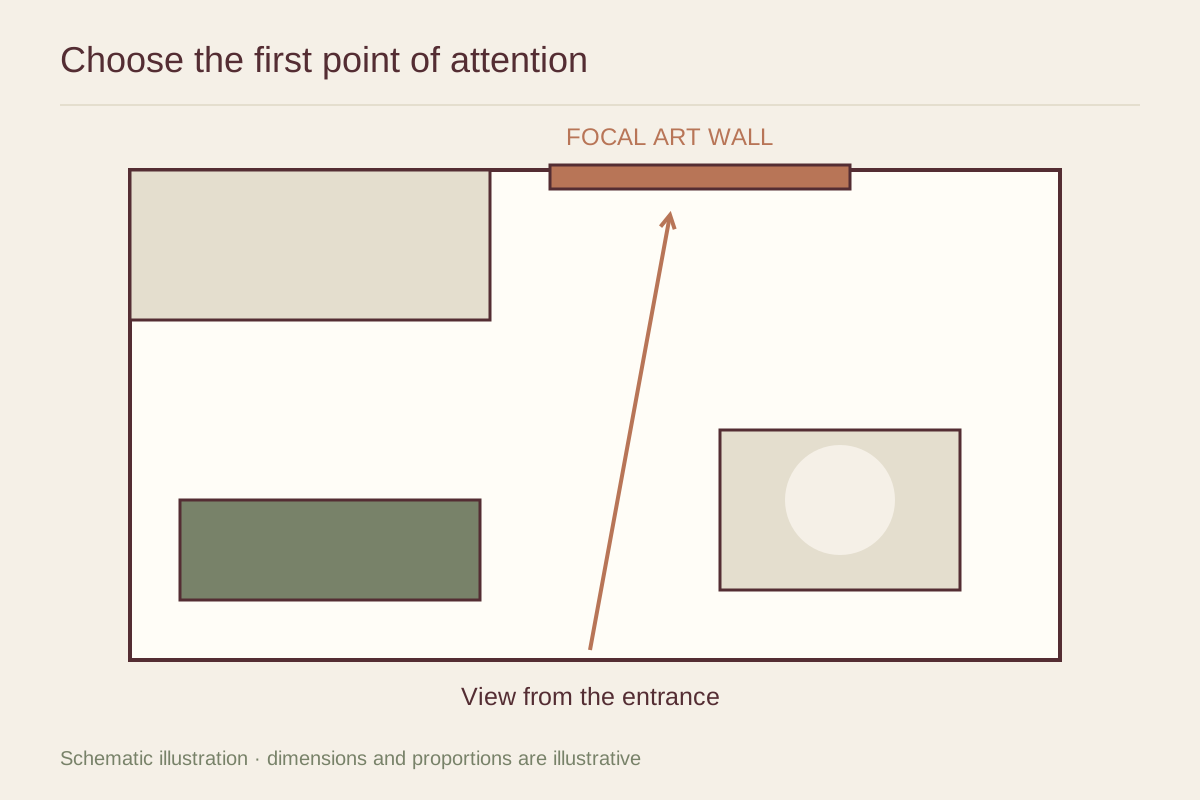
Make a simple floor sketch with the entrance, primary seats, dining chairs, and major windows. Draw a line from each viewing position toward the walls that could hold art. You do not need an architectural plan; the purpose is to identify the wall that is consistently visible and the ones seen only from one corner.
Stand in those places and take ordinary photographs without an extreme wide-angle setting. Include the furniture and the edges of adjacent zones. A cropped wall photo can make a picture look perfectly placed while hiding the kitchen cabinets or pendant that will share its real view.
Choose one job for the main work
If the artwork belongs to the seating area, relate it to the sofa and chairs even when the wall continues into the dining space. Centering it on the entire wall may pull it away from the group. If it serves as a destination from the entrance, the approach view may be more important than its alignment with a single table.
You can use more than one important picture in an open room, but they do not all need equal intensity. A large quiet landscape and a smaller vivid abstract can balance differently from two equally bright oversized prints. Decide which one should be noticed first from the main approach, then let the other support a separate view.
Connect zones without matching them
One shared quality can help the room feel coherent: a muted blue, a warm paper tone, a dark frame, or a repeated curved shape. Carrying every color into every zone can make the result feel overly coordinated. Art can also introduce a color that appears nowhere else if its scale and placement are convincing.
Include large fixed surfaces in the comparison. Cabinetry, counters, flooring, and a broad rug may contribute more to the view than small accessories. A frame that looks beautiful beside the sofa fabric may feel disconnected from the cabinet wall visible behind it. Test the complete setting.
Compare full-size alternatives
Place paper outlines of two or three possible frame sizes on the chosen wall. See them from the entrance and each seating position. Note when the outline starts to dominate a neighboring zone or becomes too small to register from the far end of the room.
For a large print, inspect a full-size detail or ask the seller for a close-up of the actual printed surface. The image must work at both room distance and nearby. A screen preview stretched across a photo of the room cannot confirm the quality of fine detail, paper texture, or dark tones.
Plan for light and movement
An open room often has light arriving from several directions. Check reflected windows and lamps at different times. A location that is clear from the sofa may glare from the dining table. Avoid direct sun on vulnerable artwork and discuss suitable glazing with the framer when paper or photographs are involved.
Finally, confirm that the frame does not interfere with circulation, furniture adjustments, or access to switches. Check the complete weight and wall construction before selecting hardware. The focal point should make the room easier to understand while leaving its daily routes and activities comfortable.