Find out what the order includes
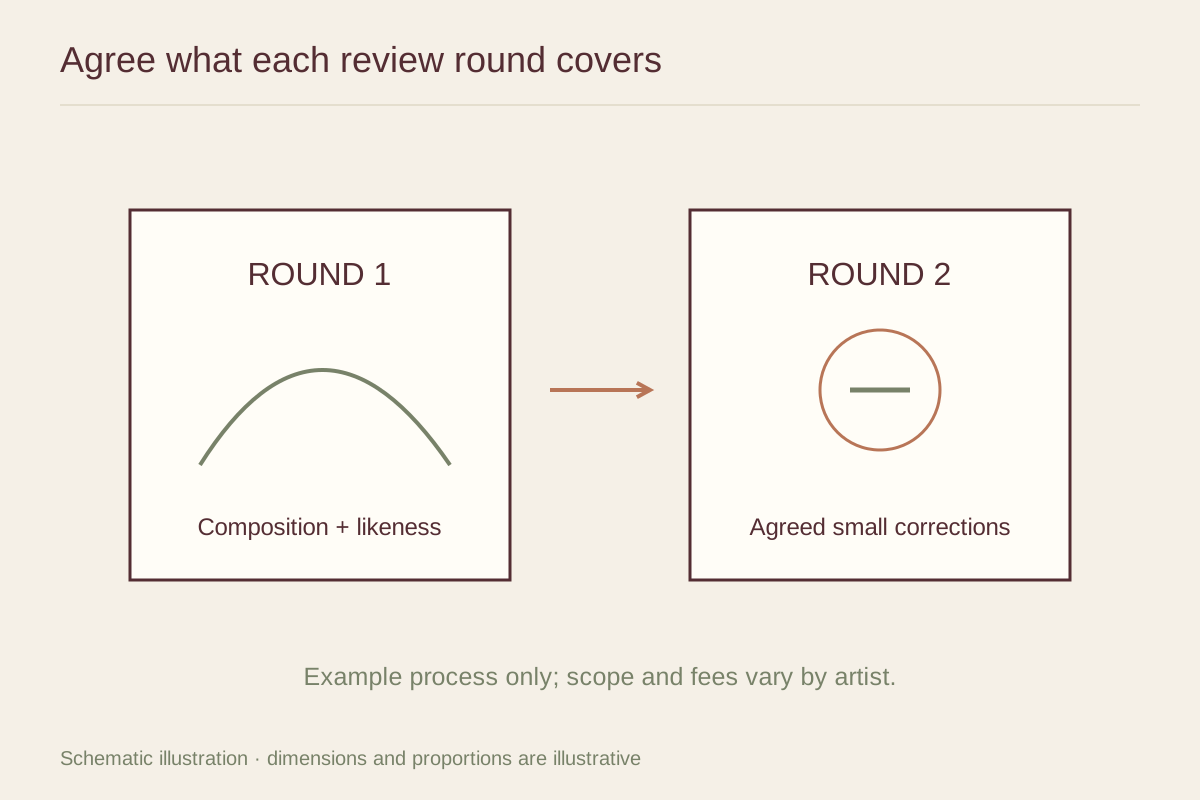
Ask how many rounds are included, when they happen and what kinds of changes they cover. A portrait service might offer one sketch adjustment and one color correction, while another may provide only a finished proof. Neither description can be assumed from the word “custom.”
Clarify whether a round means one collected list of requests or a sequence of individual messages. If you send a color change today and a pose change tomorrow, the artist may treat them as separate stages. Gathering your comments before replying can preserve the available revision opportunities.
Distinguish a correction from a new direction
A misspelled name compared with the text you supplied is different from deciding that you now prefer another name placement. An omitted pet from an agreed brief is different from adding a pet after the composition is complete. Ask how the artist handles these situations and keep the original brief available.
Changing from a loose line illustration to a realistic painted style is usually a change of direction rather than a small revision. The same can be true of replacing the main reference photograph late in the process. If your preferences are unsettled, resolve them before selecting the service.
Avoid assuming that a digital image is effortless to change. A small visible alteration may require changes to surrounding shapes, lighting or composition. The artist is best placed to explain what the request involves.
Review the whole proof before responding
Open the proof on a screen large enough to inspect faces, spelling and important details. Look once at the composition as a whole, then inspect individual areas. If the artwork will be printed small, also view it near its intended size so you do not request details that will disappear in the final object.
Write your comments in one list. Identify the subject and location precisely: “Please use the blue collar shown in photo 3” is easier to act on than “The dog still looks different.” Where possible, connect the change to a reference or an agreed detail.
Separate essential corrections from preferences you are merely considering. An artist cannot know whether “perhaps a greener background?” is a firm request, a question about feasibility or an invitation to choose. State which it is.
Keep the number of decision makers manageable
For a group gift, select one person to communicate with the artist. Other contributors can send their comments to that person, who resolves contradictions before replying. Otherwise, one relative may request a change while another asks to restore the earlier version.
If the recipient is involved, decide whether their approval is final. Continuing to add the giver’s preferences after the recipient has chosen a direction can make the commission unnecessarily difficult.
Confirm the result of the round
When the updated proof arrives, compare it with the collected requests. Check that a change has not introduced a new problem, such as a shifted caption or a detail cropped at the edge. Use the same version of the proof throughout the discussion so everyone is looking at the same image.
Ask about the cost and schedule effect of any additional work before requesting it. A paid extra round may be perfectly reasonable, but it should be a conscious choice rather than a surprise at the end.
Understand what approval does
The seller’s process determines when approval starts printing or closes the drawing stage. Read that explanation and ask if it is unclear. Save the final proof and your approval message.
A clear process does not remove every difference in taste. It gives both sides a shared way to decide what is being made, what can change and when the work is ready to become the finished gift.