Read the rules before buying hardware
Check the lease or written property guidance for holes, adhesives, picture rails, and repairs. If the wording is unclear, ask the property manager about the particular system you plan to use. Permission for small nails does not necessarily cover adhesive products, and permission for one adhesive product does not cover every surface.
Inspect the wall finish. Loose paint, wallpaper, heavy texture, damp areas, and fragile plaster can limit options. Do not treat a hidden test as proof that a product will hold a heavy frame for years. The manufacturer's approved surfaces and conditions remain the starting point.
Consider an existing picture rail
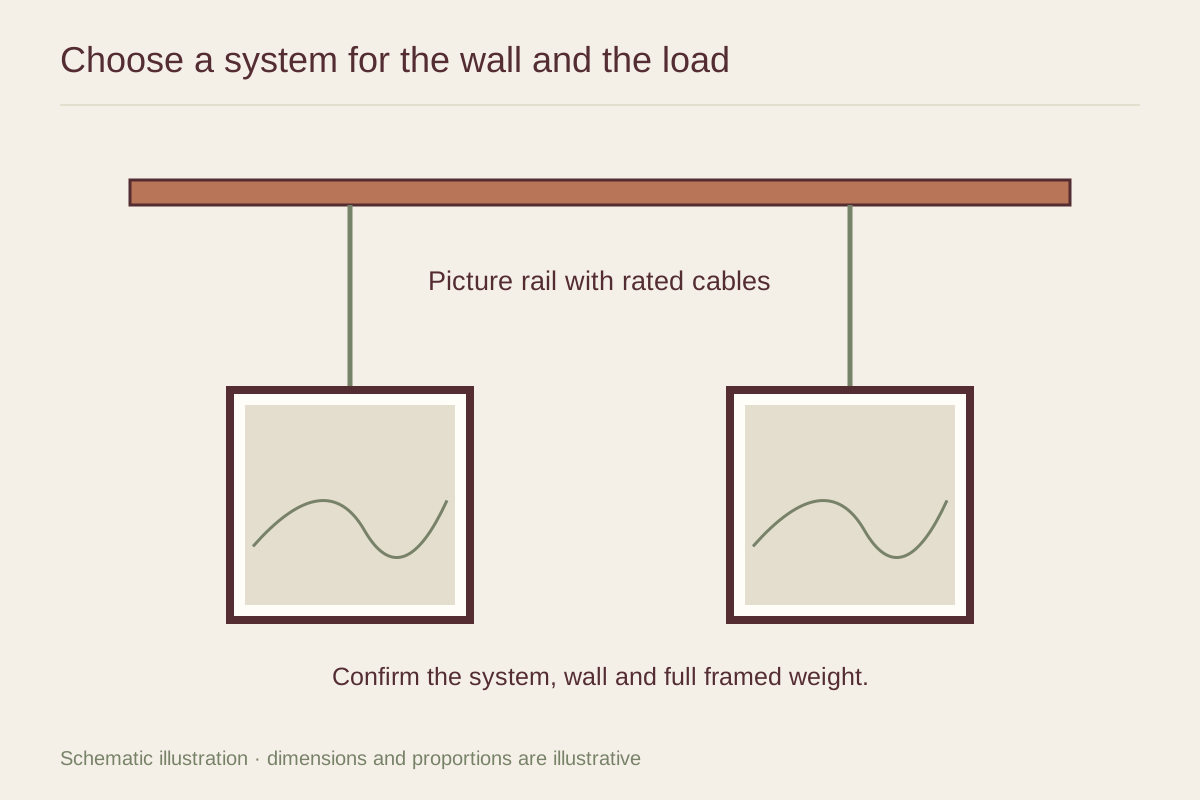
A purpose-built picture rail can allow changes without making new holes at each artwork position. Confirm that it is actually intended to support pictures and is soundly installed; decorative molding is not automatically a hanging rail. Use compatible hooks, cords or wires, and frame fittings within their stated limits.
Ask about the capacity of the complete system, including the rail installation and wall structure. Several pictures on one rail contribute to the total load. Follow the maker's instructions for spacing and attachment rather than adding separate component ratings together.
Use removable strips within their specification
For adhesive picture-hanging products, check the allowed wall surface, frame dimensions, complete weight, temperature range, and location restrictions. Use the stated number and arrangement of strips. Command's official guidance notes that adding extra strips does not automatically increase the weight limit.
Follow the specific package's cleaning, pressing, waiting, and removal steps. Similar-looking products can have different instructions. Keep the removal tabs accessible and do not conceal them in a way that makes correct removal impossible. Use fresh adhesive components when the manufacturer requires them after removal.
A wall's paint bond is part of the system. Even if an adhesive releases as designed, weak or unsuitable paint can still be affected. If the surface is uncertain or the object is valuable, heavy, or placed above a bed, choose a different permitted installation or another location. Some products expressly prohibit overhead bed use.
Evaluate permitted mechanical fixings
If small holes are allowed, a suitable picture hook or other specified fixing may offer a clear installation method. The right choice depends on the wall construction and the complete frame weight. A fixing intended for one substrate should not be assumed suitable for another.
Check for concealed services before drilling or driving fixings, and get help when the wall or access is uncertain. Agree on any required repair method before move-out. Do not perform an improvised repair that damages a finish the landlord expected to be restored differently.
Keep a removal record
Save the product instructions and note where each system is used. Photograph the installation and retain any spare parts needed for proper removal. At move-out, allow time to remove frames carefully rather than pulling everything away from the wall in a hurry.
If no permitted system suits the wall, use a stable display stand or furniture-based solution designed for the object, with appropriate restraints. A rental does not need art on every wall. A smaller number of securely displayed works is easier to enjoy and easier to move than a collection hung by methods whose limits are unknown.