Check both sides of the door
Open the door through its full range and note where the handle and edge travel. Look at how people enter with a bag or basket. A frame may clear the door itself but still sit in a route where it is repeatedly brushed.
Include switches, thermostats, and trim in the usable width. Keep controls accessible and do not hang a frame so close that fingers rub its edge whenever the light is turned on. A smaller picture can feel more intentional than a larger one compressed between these features.
Choose the right kind of detail
A small drawing, photograph, or print with subtle marks can work well where people pass nearby. If the wall is mainly seen from the next room, a simpler image may register better. Consider both the close view and the approach through the doorway.
A vertical format often suits the space, but a small square can provide a welcome pause among tall door lines. Test both with paper outlines. The frame's outside dimensions, rather than the printed sheet alone, determine how much breathing room remains.
Relate the picture to the architecture
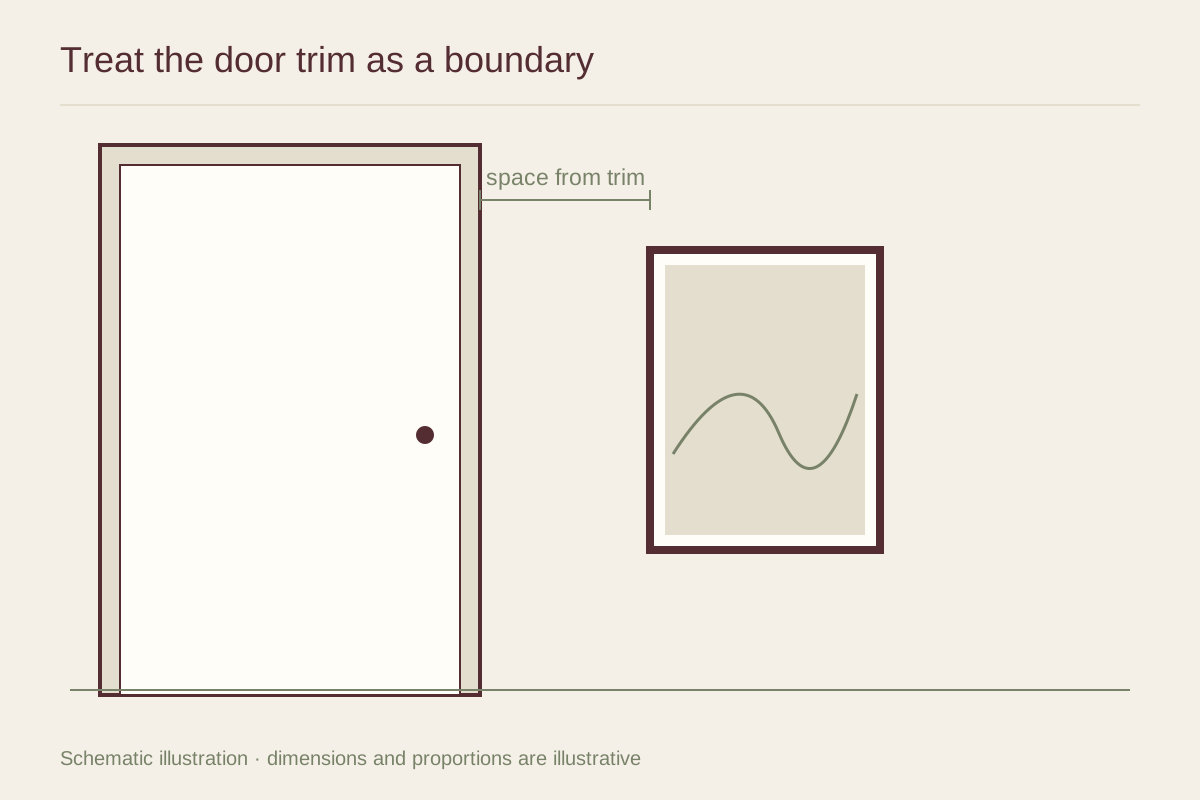
Try centering the frame within the clear strip of wall, then compare a position related to nearby furniture. The door trim may create a strong vertical boundary, but you do not have to align the artwork with its top. A comfortable viewing height is usually more useful than following a distant architectural edge.
Use a secure installation appropriate to the frame and wall, and choose a shallow profile where the passage is tight. After hanging, walk through the doorway from both directions. The display should remain easy to see without making an ordinary movement through the home feel cautious.