Ask what touches the artwork
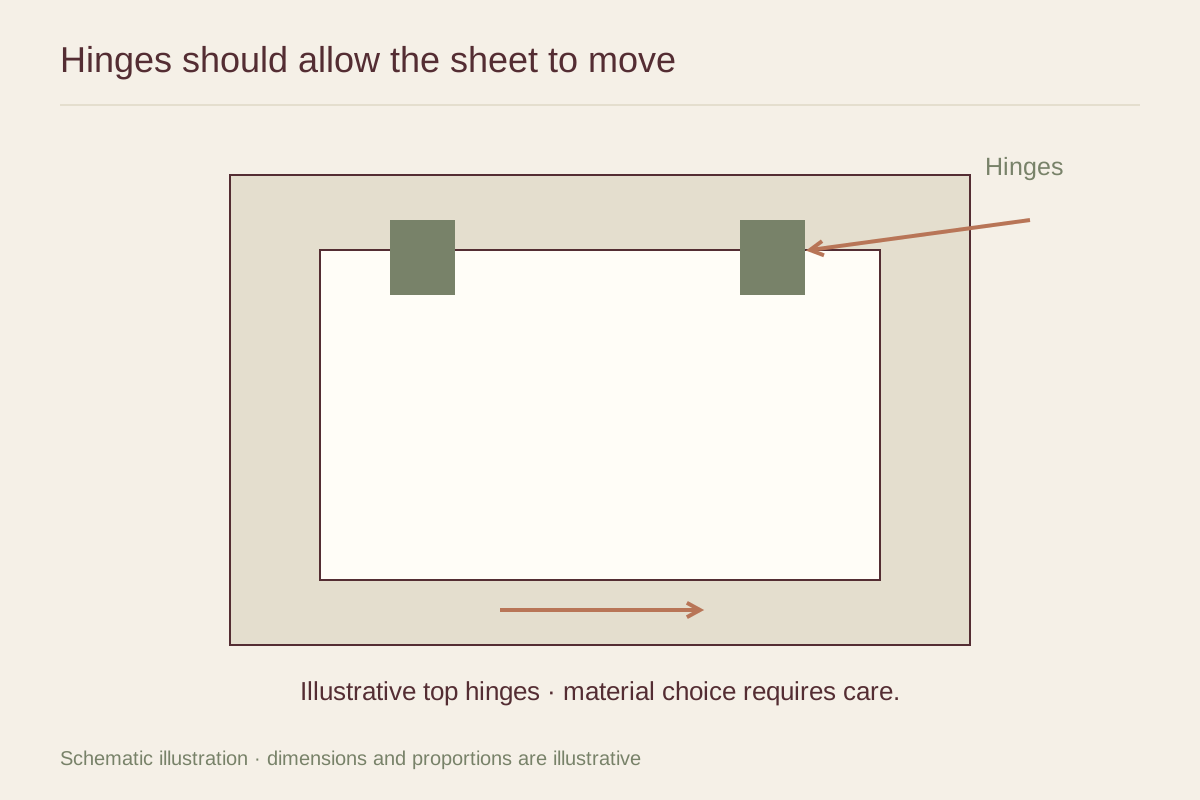
The most revealing question for a framer is simple: what will be attached to the sheet, and where? Some arrangements use edge supports or corners without adhesive on the print. Others use carefully selected hinges. The appropriate method depends on the paper's weight, size, condition, and how much of its border must remain visible.
A print under a window mat presents different opportunities from a whole sheet floating against a backing. A thin, flexible sheet differs from a heavy, stiff one. Ask for a method suited to that particular object instead of requesting the same attachment for every frame in a group.
Understand what reversible can promise
In conservation framing, reversibility concerns the possibility of removing or changing an attachment with minimal harm using appropriate methods. It is not a promise that removal will always be easy, and it is not an instruction to experiment with water, solvents, or heat. Even a well-chosen adhesive can require professional skill to remove from a sensitive paper.
NEDCC describes its mounting work as research-tested and reversible, with choices made in collaboration with conservation specialists. For a home framing order, the useful lesson is to ask for the reasoning and material record behind the claim. A label on a packet of tape provides much less information than a mounting plan for the actual print.
Distinguish temporary display from permanent bonding
Dry mounting and other full-surface bonding methods can make a decorative reproduction look flat, but they can substantially limit later options. Before approving such a process, establish whether the print is replaceable and whether you accept the change. A signature, unusual paper, sentimental importance, or uncertain history is a reason to pause and seek advice.
Do not assume that a low purchase price makes a work disposable to its owner. A family drawing or a print received from a friend may matter more than its market price. Describe that importance to the framer so the proposed method reflects your priorities.
Allow the sheet to behave like paper
Paper responds to environmental changes. An attachment that restrains it too aggressively can create stresses or distortions. The objective is appropriate support, not necessarily the perfectly rigid appearance of a printed board. Ask the framer what degree of natural movement or slight unevenness may remain visible.
A border can sometimes be concealed behind a mat while the sheet is supported with a less visually intrusive method. If you want every edge exposed, there may be a tradeoff between that appearance and the complexity of the mount. Discuss it before committing to a float presentation solely because of a room photograph.
Keep a record and leave removal to the right person
Request the names of the materials used and a brief description or photograph of the mount before the frame is closed. Store the record with the invoice. If the work is reframed years later, the next professional will have a better starting point than an unexplained strip on the reverse.
If you inherit a print already taped, glued, or bonded to something, do not pull at an edge to test how secure it is. Photograph the arrangement without dismantling a fragile assembly and ask a paper conservator about it. A future change of frame should not begin with damage caused by trying to prove whether an old mount was reversible.