Identify the collage's anchor
Even a busy collage often has a largest shape, a repeated color, or a dark area that holds the composition together. Find that anchor before choosing the size. If the print is reduced too far, the larger structure may collapse into a collection of tiny details.
View a small preview from a distance. What do you notice first? If there is no clear answer, the image may need a larger size or a quieter wall. A focal point should give the eye somewhere to arrive, even if it offers many discoveries on closer inspection.
Borrow less than you think
Select one dominant color and perhaps one small accent for the room connection. A green field in the collage might relate to a chair, while a little ocher appears in a cushion. Leave the other colors within the artwork so it retains its range without spreading visual activity across every surface.
Keep nearby patterns in proportion. A dense collage beside a busy bookshelf and patterned curtains may compete with both. That does not mean the room must be plain; it means the art needs a defined area where its own arrangement can be read.
Give the edge a clear boundary
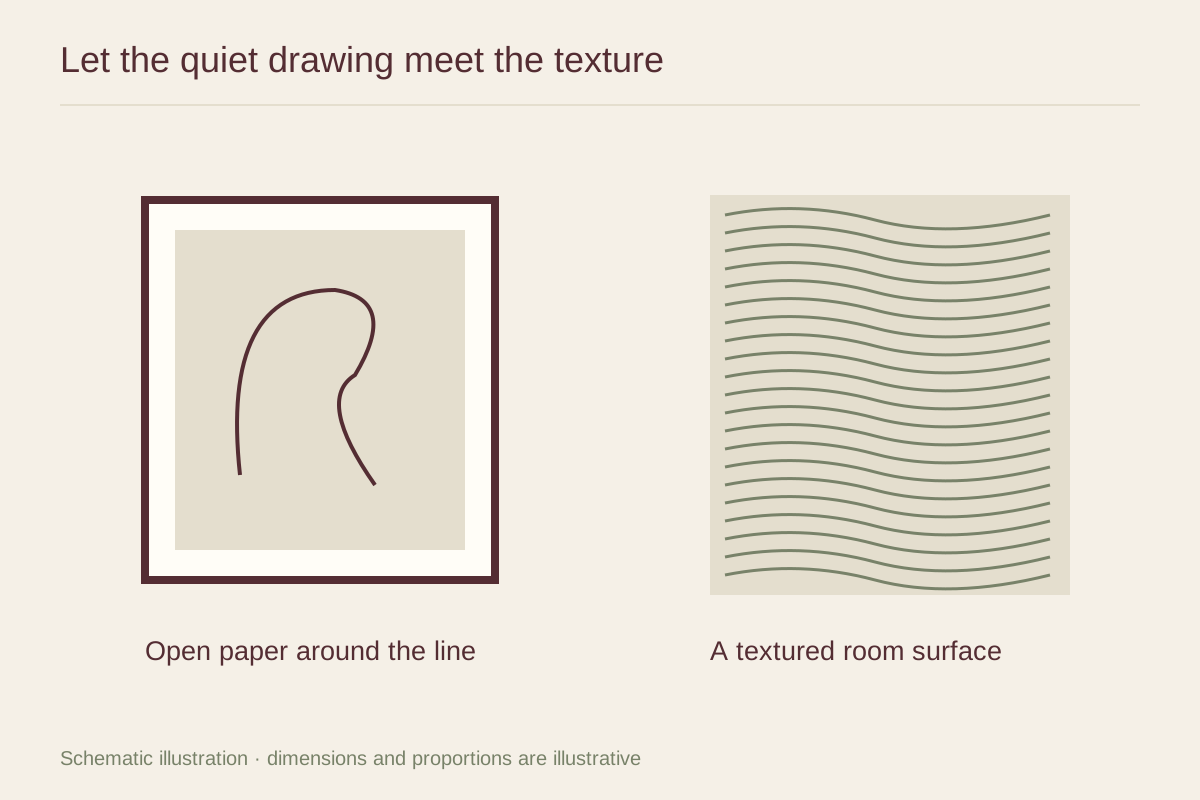
A simple frame can contain the fragments without adding another motif. A mat may be helpful when the collage reaches the edge of the paper, but compare it with a closer frame treatment. A broad white margin changes the apparent scale and can make a lively image feel more formal.
Check the print quality in areas with small text or photographic fragments. A deliberate rough edge is different from a low-resolution reproduction. Ask for a detail view if the listing shows only a room mockup. Once hung, remove one nearby accessory temporarily and see whether the collage becomes clearer. A strong focal image often needs less support from surrounding objects than expected.